Aluminium Composite Panel Price - What Determines the Cost?
Aluminium composite panels↗ are widely used as façade cladding materials for modern buildings. They can be used both on the façades of new buildings and for the renovation of existing buildings, as well as for cladding various architectural elements.
The price of an aluminium composite panel is not determined solely by the cost of one square metre of material. The final cost is influenced by the technical characteristics of the panel itself, the façade area and architectural form, the substructure, thermal insulation, panel processing, installation complexity, and other technical requirements of the project.
For this reason, the cost of two seemingly similar aluminium composite panel façades can differ significantly.
What Is an Aluminium Composite Panel?
An aluminium composite panel is a multi-layer cladding material↗ that mainly consists of two aluminium layers with an inner core between them. This structure allows a relatively lightweight panel to maintain the strength and dimensional stability required for façade cladding.
Composite panels↗ are available in different overall thicknesses, aluminium skin thicknesses, core types, surface coatings, colours, and textures. These characteristics distinguish different types and classes of products and directly affect their cost.
Composite Panel Core Types – PE, FR and A2
The type of core material has a significant impact on the price and technical characteristics of an aluminium composite panel. Three main categories of panels are generally distinguished:
PE – A standard type of composite panel that offers a relatively economical solution but has limited fire safety performance.
FR – A fire-retardant core (a material that is difficult to ignite), which also contains mineral components. Compared to standard PE panels, it offers improved fire safety performance.
A2 – A composite panel with a high mineral content, characterised by high fire safety performance. According to the European EN 13501-1 standard, A2-class panels belong to the category of practically non-combustible materials and are used in projects where particularly high fire safety requirements apply.
Our partners↗ in the composite panel sector:
The type of core material affects the panel's weight, cost, and possible applications. When selecting a specific panel, it is important to consider the building's purpose, height, project technical requirements, and relevant fire safety regulations.
What Determines the Price of an Aluminium Composite Panel?
Panel thickness - One of the main characteristics is the overall thickness of the composite panel.
Products intended for different applications may have different thicknesses, and the appropriate option should be selected according to the specific application, façade system, and technical requirements of the project.
However, the overall thickness of the panel alone is not sufficient to assess its quality or cost.
Aluminium skin thickness - The thickness of the aluminium layers on both sides of the composite panel is an important technical parameter.
Two visually similar panels may be manufactured with different aluminium skin thicknesses. Therefore, comparing only the overall panel thickness or visual appearance does not provide the complete picture.
When selecting a product for a façade project, it is important to evaluate the full technical specification of the particular panel.
Panel core and fire-performance characteristics - Aluminium composite panels also differ according to the type of inner core.
Various product categories are available on the market, including PE, FR, and panels containing mineral cores with higher fire-performance characteristics. Their composition and reaction-to-fire characteristics differ, affecting both their suitability for particular applications and their price.
When selecting a panel for a specific project, it is important to consider the building's purpose, height, applicable technical and fire-safety requirements, and the relevant product certification. Therefore, a façade panel should not be selected solely on the basis of the lowest price.
Surface coating, colour, and texture - The surface finish of a composite panel also affects its cost.
Panels are available in a variety of colours, metallic effects, wood- or stone-effect textures, and other decorative finishes.
The type of coating used is also important because the exterior surface of a façade is constantly exposed to solar radiation, moisture, temperature changes, and other environmental conditions. The use of a specific colour, special texture, or custom-selected finish for a project may also affect the cost of the product.
Panel dimensions and material optimisation - The total façade area is important, but cost does not depend solely on the overall surface area.
It is also important to consider how the façade is divided into individual panels and how efficiently standard-size material can be used. Cutting panels according to architectural modules, openings, corners, and other elements may result in material waste.
Proper planning and cutting optimisation allow the material to be used more efficiently and help reduce unnecessary waste.
Architectural complexity of the façade - Two façades with the same surface area can have completely different levels of complexity.
A façade with a straight and uniform surface is relatively straightforward to process, while multi-angled forms, openings, different planes, decorative elements, and non-standard geometry require additional technical processing.
The more complex the architectural form of the building, the more individual components need to be fabricated, cut, formed, and precisely connected. Consequently, architectural complexity affects both material consumption and the scope of fabrication and installation work.
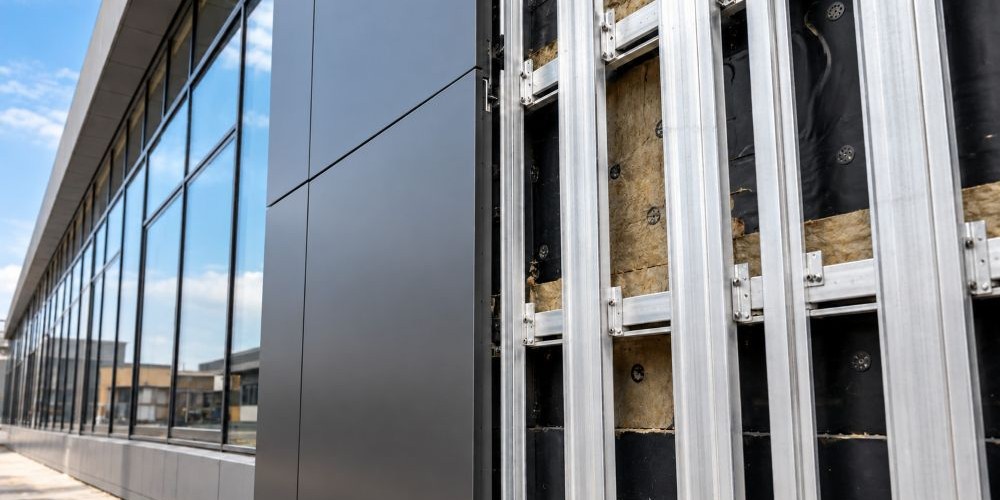
Aluminium substructure - A composite panel is not attached directly to the façade on its own.
A supporting structure is installed behind it, onto which the processed panels are mounted. The configuration of this structure depends on the form of the building, the façade system solution, panel dimensions, wind loads, and other technical factors.
Therefore, when assessing the cost of an aluminium composite panel façade, it is necessary to consider not only the visible cladding material but also the complete structure behind it.
Thermal insulation - If the façade solution also incorporates thermal insulation, the appropriate insulation material and its installation represent another component of the project's overall cost.
The type and thickness of thermal insulation should be determined according to the building's energy-efficiency requirements and the technical design of the façade. Consequently, two visually similar composite façades may have completely different structural compositions.
Panel processing and cassette fabrication - Purchasing composite panels does not mean that the material is ready to be installed on the façade.
Depending on the project, the panels need to be cut to precise dimensions, processed, formed as required, and prepared into the appropriate components (we fabricate façade elements in our own facility, and our team carries out their installation). This stage is particularly important for types of composite façades where each element is fabricated according to a specific façade module.
Fabrication accuracy ultimately affects the alignment of façade lines, the quality of joints, and the overall visual result.
Building height and installation conditions - The height of the building and the working environment have a significant impact on installation costs.
Working on a high-rise building may require scaffolding, lifting equipment, specialised platforms, or other work equipment. Site accessibility, the ability to move materials around the site, the sequencing of works, and coordination with other participants in the construction process are also important factors.
Therefore, knowing only the façade area is not sufficient to determine the actual installation cost.
Why Is There No Single Price per Square Metre for Every Project?
One of the first questions is often: How much does one square metre of aluminium composite panel cost?
If the requirement is only to purchase a specific panel, it is possible to determine the unit or square-metre price according to its specification. However, in the case of a complete aluminium composite panel façade, a single universal price cannot realistically reflect the true cost of the project.
The final cost may include panels, substructure, thermal insulation, fixing elements, panel processing, fabrication of individual components, transportation, work equipment, and installation.
Therefore, an accurate price can only be determined after evaluating the requirements of the specific project.
How Is the Cost of an Aluminium Composite Panel Façade Assessed?
The first stage is to review the architectural and technical information of the project. The façade area and geometry, the type and characteristics of the selected panel, the substructure solution, thermal insulation requirements, panel modules, building height, and installation conditions must all be determined.
The required quantity of materials, scope of fabrication, and installation works can then be assessed.
This approach provides a much more accurate picture than simply comparing the price per square metre of the panel.
The Composite Façade as a Complete System
The final result of an aluminium composite panel façade does not depend solely on the quality of the selected panel. Proper panel selection, the engineering solution for the substructure, optimal material layout, precise fabrication of individual components, and high-quality installation are all important.
See ongoing and finished projects↗
For each project, we assess its architectural and technical requirements, select the appropriate materials, develop the necessary technical solutions, fabricate the façade elements in our own facility, and carry out their installation with our own team.
A properly designed composite façade should meet not only the building's visual concept but also its requirements for safety, durability, energy efficiency, and long-term performance.
- Share


Similar news
Our
customers
Hear from our customers about their experiences


What sets Luminor apart is their ability to offer solutions and empower you, despite the challenges.”


FAQ
You can find answers to the most frequently asked questions easily and in detail here.
We are a company specializing in the production and installation of architecturally sophisticated aluminum facades, doors, windows, railings and roofing systems. Our own factory, experienced engineering and installation team allow us to turn projects of various scales and complexity into reality.
For each project, we individually develop technical components and select appropriate systems and materials. Based on the specifics of the project, we manufacture the necessary structures in our own factory, and our team ensures their delivery and professional installation.
Yes. It is possible to use both the full service and purchase individual products and materials without installation services.
Yes, our own specialized team ensures professional installation of all structures.